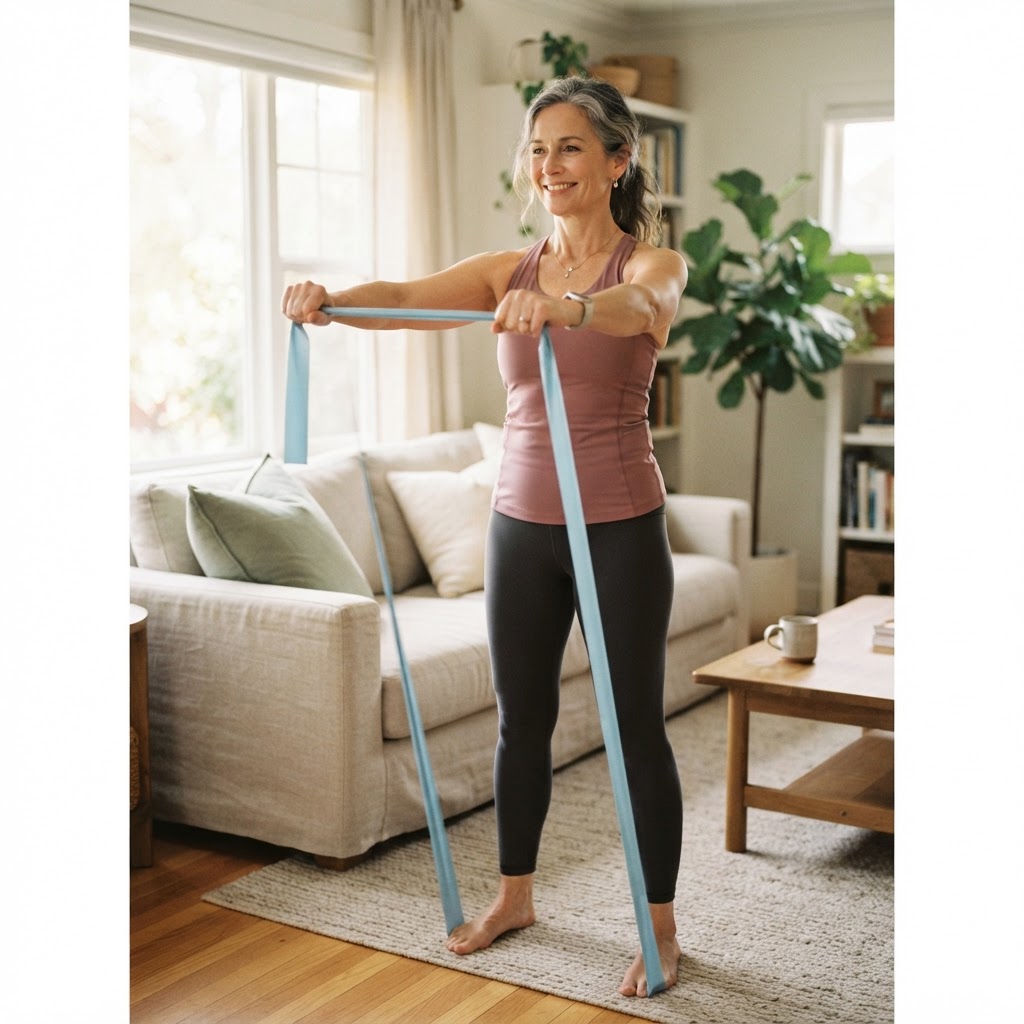
If there's one form of exercise that deserves a bigger place in midlife women's routines, it's strength training. Not because it burns the most calories — it doesn't — but because it does something almost nothing else can: it protects and builds the muscle that menopause is quietly taking away.
This article is a practical, honest guide to strength training during and after menopause: why it matters, what it does, and how to start without a gym, without intimidation, and without becoming someone you're not. For the wider picture of how movement fits into midlife weight management, start with our complete guide to menopause belly fat.
Why strength training matters more in midlife
From your thirties onwards, your body becomes less efficient at holding onto muscle unless you give it a reason to. That reason is resistance — working your muscles against something harder than they're used to. Without it, the natural course is a slow, steady loss of muscle.
This matters more in midlife for two reasons.
First, muscle is metabolically active tissue — it uses energy even at rest. Less muscle means a slightly lower resting metabolism, which makes weight management harder. Second, the hormonal changes of menopause accelerate the loss of muscle if you're not countering it. So strength training isn't a vanity project; it's the most direct way to protect the part of your body that keeps your metabolism steady.
There's also a quieter benefit: strength training makes daily life easier. Carrying shopping, climbing stairs, playing with grandchildren, getting up from the floor — all of these depend on muscle. The strength you build now is the independence you keep later.
What strength training actually does
- Preserves and builds muscle. Working against resistance signals your body to keep (and grow) the muscle you have.
- Supports your metabolism. More muscle means a slightly higher resting energy use.
- Improves insulin sensitivity. Muscle is where your body stores carbohydrate from meals; more, better-used muscle helps blood sugar stay steadier.
- Strengthens bones. Resistance work stresses bones in a way that encourages them to stay dense — particularly important after menopause, when bone density naturally declines.
- Changes body composition. You may not see the scale move much, but fat goes down and muscle comes up, so your shape changes.
What strength training does not do is spot-reduce belly fat. No exercise does. But it changes the conditions that make belly fat more likely to stick around.
How to start (without a gym)
You don't need a gym, a trainer, or expensive equipment. You need something that gives your muscles more to do than they're used to, and you need to do it consistently.
Bodyweight is enough to begin. Squats, wall push-ups, lunges, glute bridges, and planks all use your own weight as resistance. They're free, they're effective, and they teach you the movements before you add load.
Resistance bands are the best low-cost step up. They're cheap, light, easy to store, and they let you adjust resistance without buying weights. A single set of bands is enough for a full-body routine.
Light dumbbells come next. Once bodyweight and bands feel manageable, a pair of light dumbbells (or even two water bottles) adds progression.
Two to three short sessions a week is plenty. You don't need hour-long workouts. Twenty to thirty minutes, two or three times a week, done consistently, is enough to signal your body to keep its muscle.
Rest matters. Muscle is built between sessions, not during them. Leave a day between working the same muscle group.
A simple weekly shape
There's no single right routine, but a workable shape for most midlife beginners looks like this:
- Two or three strength sessions of 20–30 minutes, with at least a day between them
- Walking most days — the most underrated complement to strength work (we cover it in our guide to walking and menopause weight loss)
- One or two rest days where you move gently but don't train
The exact exercises, sets, and reps that are right for you depend on your starting point and any joint or health considerations — and that's the kind of detail a structured plan works out properly. For a broader look at how to combine movement types, our menopause exercise guide is the hub.
Protein is the other half of the equation
Strength training gives your body the reason to keep muscle; protein gives it the building blocks. One without the other is only half the work. If you're strength training, eating enough protein becomes genuinely important — we cover why in our article on protein and menopause belly fat.
Common worries
"I don't want to get bulky." Women in midlife don't accidentally get bulky from strength training — the hormone environment makes building large muscle mass difficult without years of deliberate, heavy training. What you'll get is firmer, stronger, and more defined, not bigger.
"I'm too old to start." You're not. Studies show women in their 60s, 70s and beyond build muscle when they start resistance training. The best time to start was twenty years ago; the second best time is this week.
"I have joint issues." That's worth speaking to a physiotherapist or GP about, but it's often a reason to strength train (carefully), not to avoid it. Stronger muscles support joints.
A structured approach
Knowing why strength training matters is the easy part. Doing it consistently — knowing which exercises, how many, how often, and how it fits with the rest of your week — is where most women stall. The Two Week Tummy Tuck builds the movement (and the meals around it) into a clear 14-day plan, so you follow along instead of planning every session. If that's what you're looking for, you can learn more about the programme here.
Further reading
- Menopause Belly Fat: The Complete Guide — our pillar guide to why belly fat changes and what you can do
- Menopause Exercise for Weight Loss — the complete guide to exercise in midlife
- Best Exercises for Menopause Belly Fat — what works and what to skip
- Protein and Menopause Belly Fat — why protein matters more now
Frequently asked questions
Start your 14-day programme today
Put what you've learned into practice with a simple, effective 14-day plan designed specifically for women going through the menopause. Reduce inches from your waistline and feel more confident in just two weeks.