If you've been following the science of menopause and weight gain, you already know the main story: declining oestrogen changes where your body stores fat, shifting it from hips and thighs to the belly, and traditional calorie-counting struggles to shift it. We've explored that in detail in why belly fat increases after menopause and why calorie counting doesn't work during menopause.
But a wave of research published through 2024 and 2025 has added a third player to that story — one that may be the best news yet for anyone who would rather change what's on their plate than reach for a pill. It's your gut bacteria. And the way they interact with oestrogen is quietly rewriting how we think about menopause belly fat.
This isn't a supplement pitch, and it isn't a claim that fermented foods will replace hormone therapy. It's an honest look at what the emerging science actually shows — and why it points, once again, to the way you eat as the most powerful lever you control.
Meet the Estrobolome
Inside your gut lives a collection of bacterial genes with a specific job: managing your body's oestrogen. Scientists call this the estrobolome — a word that sounds technical but describes something beautifully simple.
Here's how it works. Your body makes oestrogen, uses it, then packages it up (a process called conjugation) and sends it to the gut to be excreted. But before it leaves, certain gut bacteria produce an enzyme called beta-glucuronidase that unpacks the oestrogen again, reactivating it so it can be reabsorbed back into your bloodstream and reused.
In other words, your gut bacteria help decide how much of the oestrogen your body produces actually stays in circulation. They're not making oestrogen from scratch — they're influencing how much your body gets to keep.
This matters enormously after menopause. When your ovaries were producing plenty of oestrogen, the gut's recycling role was a minor contributor. But once ovarian oestrogen drops, the proportion of your oestrogen that comes from non-ovarian sources — including this gut-driven recycling — becomes far more significant. A 2022 study using data from over 1,300 women found that in premenopausal women, gut diversity showed little correlation with oestrogen levels, but in postmenopausal women, gut diversity correlated strongly with circulating oestrogen. The gut's role becomes proportionally bigger exactly when oestrogen matters most.
What Menopause Does to Your Gut
The relationship runs in both directions: oestrogen shapes your gut bacteria, and your gut bacteria shape your oestrogen. So when oestrogen falls during menopause, the gut changes too.
Multiple human studies — from China, Spain, and the United States, some involving over a thousand women — have found remarkably consistent patterns. After menopause, women tend to have lower overall microbial diversity, with a depletion of beneficial bacteria like Akkermansia muciniphila, Bifidobacterium, and Roseburia, and a shift toward different bacterial populations.
This is not, to be clear, a sign that your gut is "broken." It's a shift — a response to a changed hormonal environment, much like the shifts in fat storage we already know about. And like those shifts, it's something you can influence.
The important nuance from the research: some studies suggest that certain bacteria actually increase their oestrogen-recycling activity after menopause, as if the gut is trying to compensate for the drop in ovarian supply. It's a reminder that your body is always working with you, not against you — even when the results feel frustrating.
The Belly Fat Feedback Loop
Here's where the story connects to the one we've been telling all along about insulin resistance and menopause.
Research reviewed in a 2025 paper in the journal Nutrients found that obesity is associated with elevated beta-glucuronidase activity — meaning the gut of someone carrying more visceral fat may be recycling more oestrogen. This creates a feedback loop: visceral fat produces inflammatory signals that can disrupt metabolism, the changed gut recycles oestrogen differently, and the hormonal environment that encouraged the belly fat in the first place is reinforced.
This is not a single cause of menopause belly fat. The oestrogen decline, insulin resistance, cortisol, sleep disruption, and now the gut–oestrogen axis are all layers of the same picture. But the gut adds something important: a mechanism that helps explain why the same diet affects different bodies differently, and why food quality — not just quantity — seems to matter so much in midlife.
It also reinforces something we've written before: the foods that make menopause belly fat worse, which we covered in this article, may do so partly through their effect on the gut bacteria that handle oestrogen. A diet low in fibre and high in refined sugar doesn't just spike insulin — it also starves the very bacteria that support healthy oestrogen metabolism.
The Good News: Food Is the Lever
If the gut–oestrogen axis sounds like bad news — one more thing going wrong — it isn't. It's genuinely the opposite. Because unlike your ovarian oestrogen, which you can't talk back to, your gut bacteria respond remarkably quickly to what you eat. And the foods that help are exactly the foods the Two Week Tummy Tuck is built around.
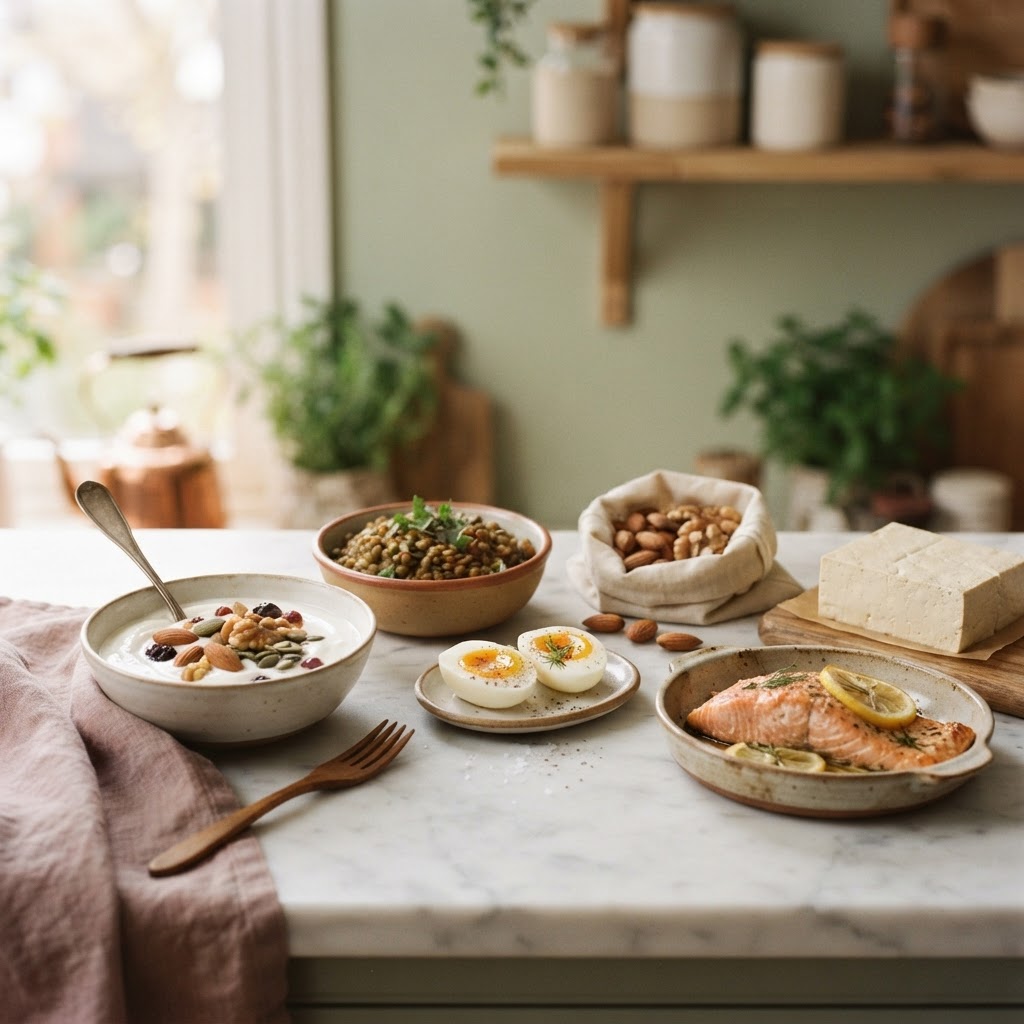
Fibre is the foundation. The bacteria that produce beneficial short-chain fatty acids — the ones associated with metabolic health — feed on fibre. Vegetables, legumes, whole grains, nuts, and seeds give these bacteria what they need to thrive. When they thrive, the gut environment that supports balanced oestrogen handling thrives too.
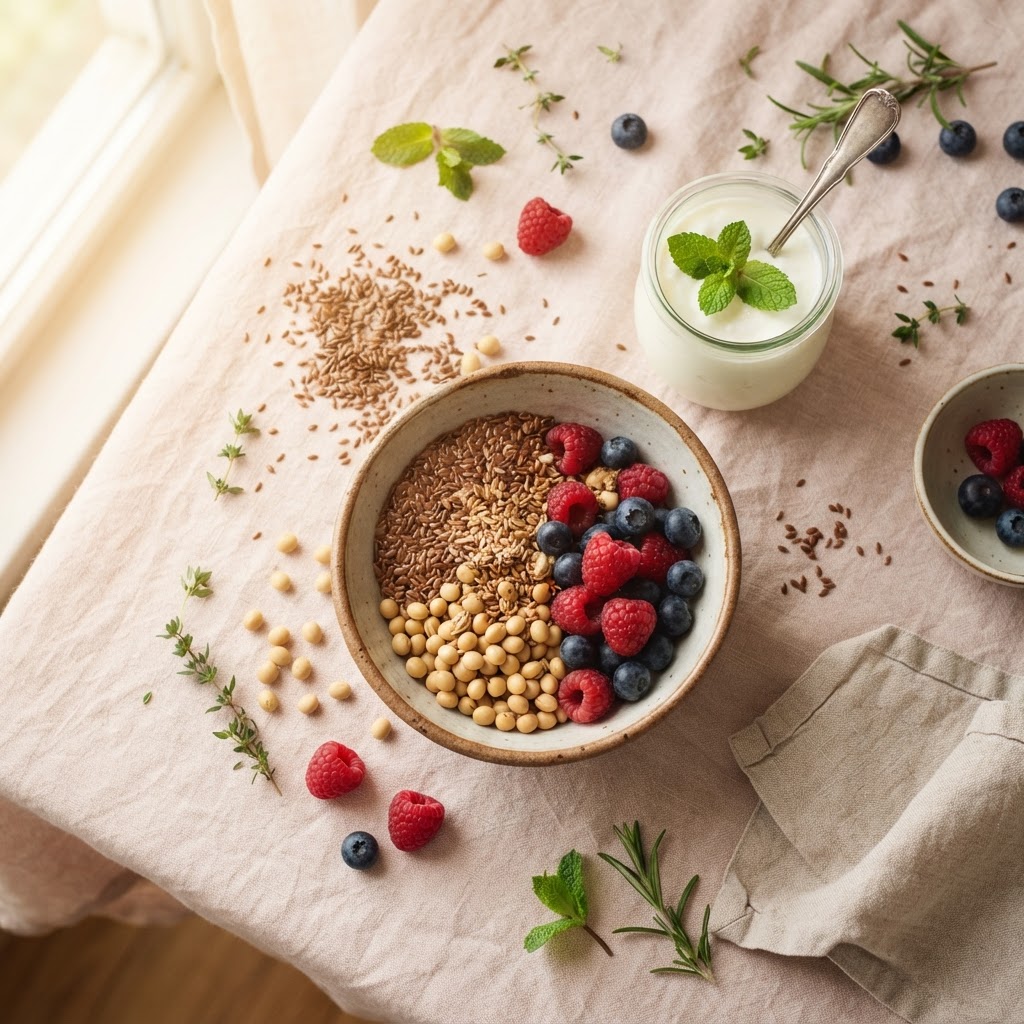
Phytoestrogen foods give bacteria raw material. Flaxseeds, soy, lentils, and other legumes contain compounds that gut bacteria convert into mild oestrogen-like molecules. The human evidence on phytoestrogens is mixed and modest — they are not a replacement for oestrogen — but as part of a whole-food diet they give your gut bacteria one more tool to work with.
Polyphenol-rich foods. Berries, olive oil, green tea, and colourful vegetables feed beneficial bacteria and have been associated with improved metabolic markers in midlife.
What to reduce. The same foods that drive insulin resistance — refined sugar, ultra-processed foods, excess alcohol (which we explored here) — also tend to disrupt the bacterial populations that support healthy oestrogen handling. The mechanism is different, but the dietary advice points the same direction.
The unifying principle is the one this plan has always taught: what you eat signals to your body, and your body responds. The gut–oestrogen axis is simply a newly understood channel through which that signalling happens.
What About Probiotics?
This is the part of the science that gets oversold, so let's be precise.
There is one genuinely interesting randomised, placebo-controlled trial: a probiotic formula containing a specific strain of Lactobacillus brevis (KABP052), selected for its beta-glucuronidase activity, was shown to preserve serum oestrogen levels in peri- and postmenopausal women after twelve weeks, compared to placebo. Another trial found a synbiotic preparation attenuated bone loss in early postmenopausal women with higher BMI.
These are real findings, and they're encouraging. But they are early, small, and strain-specific. As one careful review of the evidence put it: no probiotic has yet been shown to reliably "restore" the estrobolome or to treat menopause symptoms through it. Results depend on the exact strain, the dose, and the individual — and the long-term effects of supplementing are not well studied.
This is exactly the logic we applied in our article on GLP-1 medications and menopause: a supplement or medication can create a window of opportunity, but it cannot build the foundation that sustains results once the window closes. A probiotic pill taken alongside a diet that starves your beneficial bacteria will do very little. A diet that nourishes those bacteria will do most of the work on its own.
So the honest position is this: probiotics are an emerging area worth watching, not a shortcut worth betting on. Food first, always.
What This Means for the 14-Day Plan
Here's the most encouraging part of the research. The dietary patterns the estrobolome science points to — high in fibre from vegetables and legumes, rich in phytoestrogen foods like flax and soy, low in refined sugar and ultra-processed food, moderate in polyphenol-rich plants — are essentially the same patterns the Two Week Tummy Tuck is built around.
This isn't a coincidence. The plan was designed around the hormonal realities of menopause before the estrobolome was widely discussed. The new research doesn't overturn the approach — it provides a biological explanation for why the approach works. The fibre isn't just filling you up; it's feeding the bacteria that support your body's oestrogen handling. The whole foods aren't just lower in calories; they're giving your gut the signals it needs to work with your changed hormones rather than against them.
Fourteen days is enough time to begin shifting the gut environment. Research on dietary interventions and the microbiome consistently shows that bacterial populations can begin to change within days of a dietary shift — though the deeper, more stable changes take consistency over weeks and months. The plan is a reset that starts that process and teaches you the patterns that sustain it.
The Bottom Line
Your gut bacteria are not a new cause of menopause belly fat. They're a newly understood part of the existing story — a layer that connects the food you eat to the hormones that decide where your body stores fat.
And that is genuinely good news, because it means the lever was never out of your hands. You can't instruct your ovaries to make more oestrogen. You can't rewrite your genetics. But you can, three times a day, choose foods that nourish the bacteria that support your body's hormonal balance — and in doing so, work with the menopause transition rather than feeling at war with it.
The science will keep filling in the details. The foundation won't change. Eat real food, plenty of plants, enough fibre, and let your gut do what it evolved to do.
Further reading
- Menopause Belly Fat: The Complete Guide — our pillar guide to why belly fat changes and what you can do
- What to Eat for Menopause Belly Fat — nutrition principles that genuinely help
- Foods That Make Menopause Belly Fat Worse — what to limit and what to choose instead
- Insulin Resistance and Menopause — the missing link to belly fat
Start your 14-day programme today
2+ inches off your waistline in 2 weeks.
Put what you've learned into practice with a simple, effective 14-day plan designed specifically for women going through the menopause. Reduce inches from your waistline and feel more confident in just two weeks.